Enroll with PayPal - The Easiest and Safest for Online Banking Transactions

Sign up for PayPal and start accepting credit card payments instantly.

Thursday, November 1, 2012

7 Things About Your Other Health

There are seven things that men do not know (but they should) about their sexual health. These must must be discussed more often.


1. Reason Men Fall Asleep After Sex.

Women want to cuddle after sex but all you want to do is roll over and fall into a deep sleep. Do you know why? According to Dr. David McKenzie, sex therapist in Vancouver, Canada, a man’s body releases the biochemical Prolactin when he reaches orgasm which affects his body physically making him very tired. Another reason is that the fact that a man puts a lot of energy during sex, especially after climaxing which leads to sleepiness. So if you want her to get off your case about sleeping after sex, you could tell her it's because you had such an amazing time with her and just maybe she'll happily let you sleep the next time.


2. Men Go Through Libido PMS Too.
Women may think that we men are always horny (which is partly true), but the truth is that men’s libido goes through a series of peaks and valleys too, just like PMS for women. Testosterone levels shift according to this pattern every month affecting our libido, energy level, beard growth and sperm count. Why not keep track of your personal cycles and you'll be able to take advantage of your prime times and better cope with the sense of apathy the valleys bring.


3. Your Manhood Tells A Lot About Your Overall Health.
Believe it or not, your penis tells you more than just when you're horny. It can also tell you when you're having arterial problems if it's not standing tall; other than ringing the warning signs of diabetes, endocrine disorders, heart and vascular problems. However, it's not necessary to start waving the red flag as it may be telling you something else-- like fatigue, psychological factors, relationship issues, poor nutrition or lack o exercise.

4. Disrupted Sleep Causes Less Erections Which Results To Low Sexual Health.
If you're struggling with obstructive sleep apnea (OSA) you're at risk for sexual dysfunction. OSA decreases rapid-eye-movement (REM) sleep which means fewer REM erections, affecting sexual health. If you have trouble getting it up, get tested for OSA. Men who are diagnosed and treated often see an improvement in sexual functioning.

5. Environment friendly transportation not so friendly on testicles.
I know you want to do something for the Earth and you've switched to cycling instead of the usual short drive to work. But did you know that cycling can cause damage to your testicles? Although it does not cause male infertility, telltale signs of testicular damage include genital numbness, erection problems and skin irritations. That's no reason to giving up cycling. Just make sure that you were shorts with protective padding and adjust your seat's position so it doesn't put pressure on your groin.

6. Male Infertility from Varicocele.
If you noticed swelling on your scrotum, it may be a sign of enlarged veins which is also known as Varicocele, one of the most common identifiable cause of male infertility. Other possibilities include blockage in the reproductive tract and the fact that you're aging. Keep your sperm strong by eating nutritiously, exercising regularly and decreasing your stress level.

7. The Size of Penis Really Doesn’t Matter.
An average penis is about five inches when erected and three inches when flacid. So if you think that you need to be seven inches to perform better, you're wrong. That thought only decreases your confidence and lowers performance. During intercourse, penis size has little to do with partner satisfaction because most of the sensitive nerve endings are concentrated close to a woman's vaginal opening. Well, that certainly lifts the weight off our shoulders, doesn't it? Now all we have to do is convince her.

Seriously, these are the things that should be talked about more often. It would've taken a lot of pressure and pain of wondering WHY?


Friday, February 3, 2012

If Your Blood Type is...

Who can receive and give blood


PLEASE SHARE IT TO SAVE OTHER LIVES..IT CAN BE VERY HELPFUL.. This is General information so consult your Doctor for detail information because others group of blood can transfuse only during emergency under certain conditions.

Saturday, January 28, 2012

Baby Health - Mouth and Teeth Care

Baby teeth are important because they allow an infant to eat a good diet, allow for proper jaw growth, give the face its form and appearance, assist in the formation of proper speech, and most important, act as "space savers" for adult teeth. Tooth decay in babies can lead to pain, infection, malnutrition, poor weight gain, and premature loss of teeth - which can affect the development of permanent teeth. In addition, oral health problems in an infant's mouth, such as bleeding gums and cavities, increase the chance for these problems in permanent teeth. Good oral health habits -- started at an early age at home -- increase the chance for a healthy mouth during your child's young life and carry on through adulthood.

When to Start Caring for Your Baby's Teeth

It's actually a good idea to get in the habit of cleaning your baby's gums even before teeth emerge.

To clean your baby's mouth:

  1. Lay your baby in your lap with his or her head close to your chest.
  2. Gently, but firmly, rub a clean and damp piece of gauze or washcloth along both the upper and lower gums.
  3. Clean the gums at least two times a day -- after breakfast and after the last feeding of the day. Even better -- clean your baby's gums after every feeding.

What Is Teething?

Teething refers to the time when baby teeth (also called deciduous teeth or primary teeth) appear. Generally, teething first occurs between 6 months and 24 months of age. While this process is uneventful in some children; for others, it causes quite a bit of discomfort and irritability.

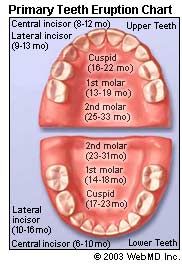
Check out this tooth chart and learn when to expect your baby's teeth to appear.

What Are Symptoms of Teething in a Baby?

Symptoms of teething in a baby can include:
  • Increased irritability
  • Placing objects or fingers in the mouth and biting down on them
  • Increased saliva or drooling
  • Loss of appetite or becoming choosy about foods
  • Tender and swollen gums
  • Rash on cheeks or redness in the area of the cheeks near the affected gums
  • Restlessness
  • Ear pulling, which may be a sign of teething or possibly an ear infection (make an appointment to have your child seen by your doctor or pediatrician)
Teething does not result in fever, vomiting, or diarrhea. If your child experiences these problems, contact your doctor.


Primary Teeth Development Chart

Primary Teeth Development Chart

Upper Teeth        When tooth emerges    When tooth falls out
Central incisor    -    8 to 12 months     -    6 to 7 years
Lateral incisor    -    9 to 13 months     -   7 to 8 years
Canine (cuspid)  -   16 to 22 months     -   10 to 12 years
First molar         -    13 to 19 months     -   9 to 11 years
Second molar    -    25 to 33 months     -   10 to 12 years

Lower Teeth        
Second molar   -     23 to 31 months     -   10 to 12 years
First molar        -    14 to 18 months    -     9 to 11 years
Canine (cuspid) -    17 to 23 months  -       9 to 12 years
Lateral incisor   -    10 to 16 months   -     7 to 8 years
Central incisor   -   6 to 10 months      -    6 to 7 years


Other primary tooth eruption facts:

A general rule of thumb is that for every 6 months of life, approximately 4 teeth will erupt.
Girls generally precede boys in tooth eruption
Lower teeth usually erupt before upper teeth
Teeth in both jaws usually erupt in pairs - one on the right and one on the left
Primary teeth are smaller in size and whiter in color than the permanent teeth that will follow
By the time a child is 2 to 3 years of age, all primary teeth should have erupted
Shortly after age 4, the jaw and facial bones of the child begin to grow, creating spaces between the primary teeth. This is a perfectly natural growth process that provides the necessary space for the larger permanent teeth to emerge. Between the ages of 6 and 12, a mixture of both primary teeth and permanent teeth reside in the mouth.


What do you call that food particles stuck in your teeth?

In every place there are terms we call for that food particle stuck between your teeth. It could be a meat or vegetables or anything else you ate. But what do you call that food particles stuck in your teeth in English?

It is called Victusinterodenta and the way to get it out is by using toothpick, floss or toothbrush. It is very important to clean your mouth and teeth at least 2 times a day or best every after meal.

Tuesday, January 24, 2012

Emergency First Aid - How to Perform CPR for Infants

CPR stands for cardiopulmonary resuscitation. It is a lifesaving procedure that is done when someone's breathing or heartbeat has stopped. This may happen after choking, suffocation, drowning, or other injuries. CPR involves:
  • Rescue breathing, which provides oxygen to the lungs.
  • Chest compressions, which keep the blood flowing.
If blood flow stops permanent brain damage or death can occur within minutes. Therefore, you must not stop these procedures until the heartbeat and breathing of the infant return, or trained medical help arrives.
This article discusses CPR performed on an infant.
Considerations

CPR can save life, but it is best done by someone has undergone CPR course or training. The procedures outlined here are not a substitute for CPR training.
Parents and those who take care of children must know infant and child CPR if they haven't already.
The newest techniques emphasize compression over rescue breathing and airway, reversing long-standing practice.

Causes
 There are many factors that make the breathing and heartbeat of infant to stop. Other reasons you may need to do CPR on an infant are the following:
  • Choking
  • Drowning
  • Electrical shock
  • Excessive bleeding
  • Head trauma or serious injury
  • Lung disease
  • Poisoning
  • Suffocation
Symptoms
Cardiopulmonary Resuscitation should be done if the infant has the following symptoms:
  • No breathing
  • No pulse
  • Unconsciousness
First Aid 

The following CPR steps are based on instructions from the American Heart Association.

  1. Check for alertness:
    • Shake or tap the infant gently. See if the infant moves or makes a noise. Shout, "Are you OK?"
  2. If there is no response, shout for help. Tell someone to call 911 or your local emergency number. Do not leave the infant yourself to call 911 until you have done CPR for about 2 minutes.
  3. Carefully place the infant on their back. If there is a chance the infant has a spinal injury, two people should move the infant to prevent the head and neck from twisting.
  4. Perform chest compressions:
    • Place 2 fingers on the breastbone -- just below the nipples. Make sure not to press at the very end of the breastbone.
    • Keep your other hand on the infant's forehead, keeping the head tilted back.
    • Press down on the infant's chest so that it compresses about 1/3 to 1/2 the depth of the chest.
    • Give 30 chest compressions. Each time, let the chest rise completely. These compressions should be FAST and hard with no pausing. Count the 30 compressions quickly: "1,2,3,4,5,6,7,8,9,10,11,12,13,14,15,16,17,18,19,20,21,22,23,24,25,26,27,28,29,30, off."
  5. Open the airway. Lift up the chin with one hand. At the same time, tilt the head by pushing down on the forehead with the other hand.
  6. Look, listen, and feel for breathing. Place your ear close to the infant's mouth and nose. Watch for chest movement. Feel for breath on your cheek.
  7. If the infant is not breathing:
    • Cover the infant's mouth and nose tightly with your mouth.
    • Or, cover just the nose. Hold the mouth shut.
    • Keep the chin lifted and head tilted.
    • Give 2 rescue breaths. Each breath should take about a second and make the chest rise.
  8. Continue CPR (30 chest compressions followed by 2 breaths, then repeat) for about 2 minutes.
  9. After about 2 minutes of CPR, if the infant still does not have normal breathing, coughing, or any movement, leave the infant if you are alone and call 911.
  10. Repeat rescue breathing and chest compressions until the infant recovers or help arrives.
Keep re-checking for breathing until help arrives.
 DO NOT 
  • Do NOT Lift the infant's chin while tilting the head back to move the tongue away from the windpipe. If you think the baby has a spinal injury, pull the jaw forward without moving the head or neck. Don't let the mouth close.
  • If the infant has normal breathing, coughing, or movement, DO NOT begin chest compressions. Doing so may cause the heart to stop beating.
 When to Contact a Medical Professional
  • If you have help, tell one person to call 911 while another person begins CPR.
  • If you are alone, shout loudly for help and begin CPR. After doing CPR for about 2 minutes, if no help has arrived, call 911. You may carry the infant with you to the nearest phone (unless you suspect spinal injury).


Prevention 
Most children need CPR because of a preventable accident. The following tips may help prevent some accidents in children:
  • Never underestimate what an infant can do. Assume the baby can move more than you think.
  • Never leave an infant unattended on a bed, table, or other surface from which the infant could roll off.
  • Always use safety straps on high chairs and strollers. Never leave an infant in a mesh playpen with one side down. Follow the guidelines for using infant car seats.
  • Teach your baby the meaning of "Don't touch." The earliest safety lesson is "No!"
  • Choose age-appropriate toys. Do not give infants toys that are heavy or fragile. Inspect toys for small or loose parts, sharp edges, points, loose batteries, and other hazards.
  • Create a safe environment. Watch children carefully, particularly around water and near furniture.
  • Keep toxic chemicals and cleaning solutions safely stored in childproof cabinets.
  • To reduce the risk of choking accidents, make sure infants and small children cannot reach buttons, watch batteries, popcorn, coins, grapes, or nuts.
  • Sit with an infant while he or she eats. Do not allow an infant to crawl around while eating or drinking from a bottle.
  • Never tie pacifiers, jewelry, chains, bracelets, or anything else around an infant's neck or wrists.


______________________________________________________________________________________________
References:

Update Date: 9/2/2011
Updated by: Jacob L. Heller, MD, Emergency Medicine, Virginia Mason Medical Center, Seattle, Washington, Clinic. Also reviewed by David Zieve, MD, MHA, Medical Director, A.D.A.M., Inc.

Thursday, January 12, 2012

The Secrets on How To Kill Your Liver

If you want to kill your liver, here are the main causes of liver damage:

  1. Sleeping too late and waking up too late are main cause.
  2. Not urinating in the morning.
  3. Too much eating.
  4. Skipping breakfast
  5. Consuming too much medication
  6. Consuming too much preservatives, additives, food coloring, and artificial sweetener.
  7. Consuming unhealthy cooking oils. As much as possible reduce cooking oil use when frying, which includes even the best cooking oils like olive oil. Do not consume fried foods when you are tired, except if the body is very fit.
  8. Consuming raw (overly done) foods also add to the burden of liver.
  9. Veggies should be eaten raw or cooked 3-5 parts. Fried veggies should be finished in one sitting, do not store.
 We should prevent this without necessarily spending more. We just have to adopt good daily lifestyle and eating habits. Maintaining good eating habits and time condition are very important for our bodies to absorb and get rid of unnecessary chemicals according to "schedule".

BECAUSE:

Evening at 9 - 11pm: is the time for eliminating unnecessary / toxic chemicals (detoxification) from the antibody system (lymph nodes). This time duration should be spent by relaxing or listening to music. If during this time a housewife is still in an unrelaxed state such as washing the dishes or monitoring children doing their homework, this will have a negative impact on health.

Evening at 11pm - 1am: is the detoxification process in the liver, and ideally should be done in a deep sleep state.

Early morning 1 - 3am: detoxification process in the gall, also ideally done in a deep sleep state.

Early morning 3 - 5am: detoxification in the lungs. Therefore there will sometimes be a severe cough for cough sufferers during this time. Since the detoxification process had reached the respiratory tract, there is no need to take cough medication so as not to interfere with toxin removal process.

Morning 5 - 7am: detoxification in the colon, you should empty your bowel.

Morning 7 - 9am: absorption of nutrients in the small intestine, you should be having breakfast at this time. Breakfast should be earlier, before 6:30am, for those who are sick. Breakfast before 7:30am is very beneficial to those wanting to stay fit. Those who always skip breakfast, they should change their habits, and it is still better to eat breakfast late until 9 - 10am rather than no meal at all.
Sleeping so late and waking up too late will disrupt the process of removing unnecessary chemicals. Aside from that, midnight to 4:00am is the time when the bone marrow produces blood. Therefore, have a good sleep and don't sleep late. 

 Follow this if you want to take care of your health,
Don't follow this if you want to kill your Liver.